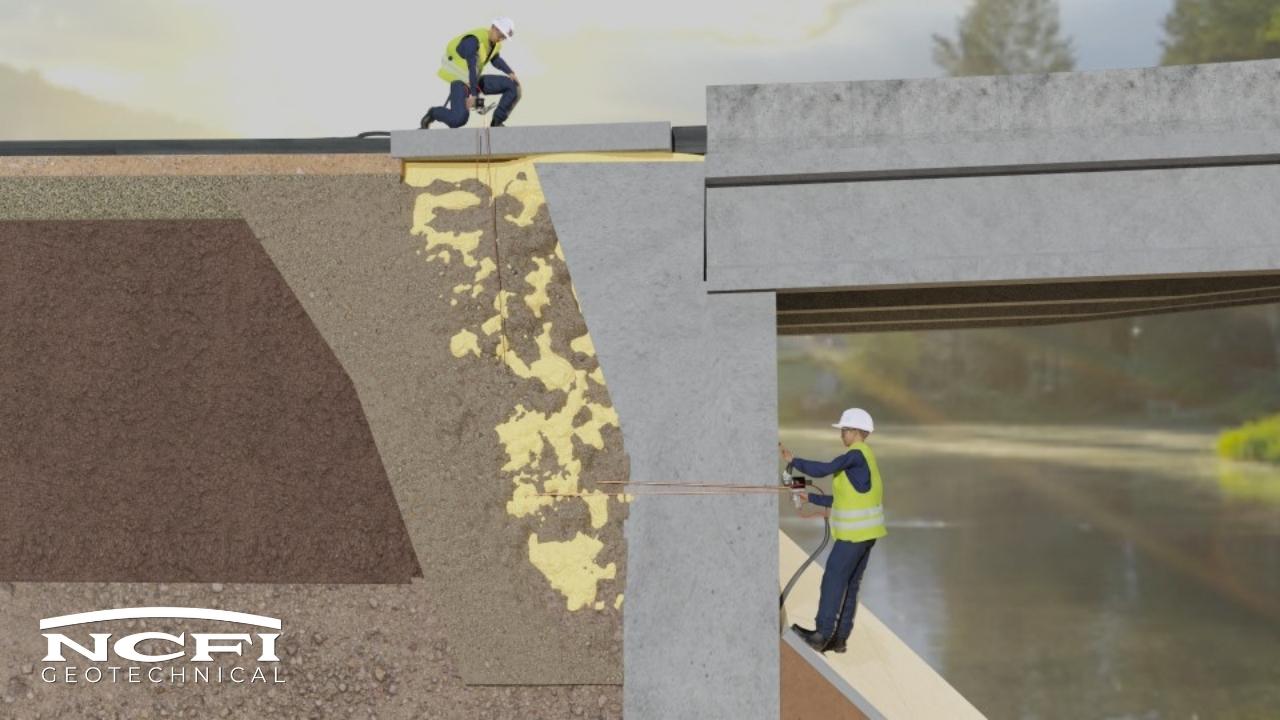
Bridge infrastructure is built to last, but not without challenges. One of the most common and often overlooked issues occurs at the bridge transition slab, the critical section that connects roadway to bridge deck. When these slabs settle or shift out of alignment, drivers experience more than just a “bumpy ride.” The misalignment accelerates wear on vehicles, creates safety risks, and can compromise the long-term performance of the bridge itself. Transition slabs are designed to absorb movement between the roadway and bridge deck, but repeated traffic loading and soil settlement can push them out of alignment. Even minor displacement creates abrupt grade changes that accelerate wear on vehicles, increase maintenance demands, and shorten the service life of the bridge. By targeting the root cause, unstable soils, polyurethane injection gives engineers a precise, minimally disruptive method for restoring alignment and extending structural performance.
Signs of Bridge Transition Slab Settlement
Bridge transition slabs settle after consistent exposure to weather, heavy loads, and traffic vibrations. When this settlement happens, there are some signs that engineers, municipal decision makers, and DOT workers can look for:
- Abrupt Grade Changes at Approaches: As transition slabs settle, the smooth connection between roadway and bridge deck is lost. Drivers often experience a noticeable jolt when entering or exiting the bridge, which not only signals misalignment but also accelerates wear on both vehicles and the structure itself.
- Cracks: Transition slabs may develop longitudinal or transverse cracks due to uneven support from the underlying soils. These cracks can be visible on the surface and may widen over time, causing ride quality to decline significantly.
- Joint Separation or Misalignment: Gaps can open at expansion joints or along the connection between the transition slab and bridge deck. In some cases, the two surfaces no longer align vertically, creating both visual and structural concerns.
- Water Pooling: Water pooling on or near the transition slabs or bridge deck may point to settlement. This incorrect drainage can damage concrete surfaces and wash away support soils.
- Irregular Pavement: Irregular wear and tear on the asphalt or concrete can indicate settlement.
How Can NCFI Geotechnical Polyurethanes Resolve Bridge Transition Slab Settlement?
Once the signs of settlement have been identified, it is time to take corrective action. Geotechnical polyurethanes are uniquely effective for stabilizing soils and realigning transition slabs. Through small, strategically placed injection points, a two-part polyurethane system is introduced beneath the slab and into the support soils. The material expands in the soil, filling voids, compacting loose soils, and lifting the slab back into alignment. This process targets the unstable soils that cause settlement while restoring a smooth, safe bridge approach with minimal disruption to traffic. During the process, contractors can often keep one lane of traffic open and moving while continuing realigning the slab. This solution is often more viable than total bridge closure and complete stopping of traffic for cities, states, and municipalities.
While NCFI does not perform contracting services, we manufacture the polyurethane systems trusted by contractors nationwide. For engineers, municipalities, or DOTs seeking bridge transition slab realignment solutions, our Find a Contractor program connects you with qualified professionals in your area who are experienced in applying NCFI products for infrastructure repair. With NCFI contractors, you can be confident that the materials used on your project meet the highest standards of quality and performance. Don’t put off bridge slab realignment! Find a contractor in our network today.